
Practice Safe Switching: Emerging U.S. Safety Standards Require World Class Products
It's no secret that Europe is ahead of the United States when it comes to the regulation of machine safety within the workplace. The European Union has adopted machinery directives that encompass a wide variety of machine safety standards while in the United States many such safety standards are in developmental stages. U.S. machine builders, however, are discovering that it is in their best interests to adopt European safety standards.
The primary motivation for this adoption is simple. Manufacturers are building machinery that gets shipped to and across Europe. Another influence is that, if manufacturers are aware of safety standards and become familiar with them, most will produce safety systems in accordance with such understood standards. Lastly, when a builder designs machines to match or exceed prevalent safety standards, they offer safer equipment to their customers and leave themselves less open to a lawsuit should an accident occur.
In this article, we will explore some European safety standards that are influencing U.S. standards, review how these standards are written in the U.S. and look at some products that machine builders can use to ensure that their machines meet these safety standards, helping to safeguard workers from risk of injury and manufacturers from risk of lawsuits.
The European Union has two families of design safety standards, EN 292 –1 and EN 292 –2, that outline and define prevailing European safety principles for machinery. Furthermore, the EN 292 –1 and –2 standards direct machine designers in very specific terms as to the best methods for implementing safeguarding equipment. European Machinery Directive 891392/EEC, Section 1.4.-1.4.1, for example, states:
Required characteristics of guards and protection devices:
European Union directive EN 1050 is another risk assessment directive that offers specific instructions about how to assess the risk of worker injury.
EN 1050 teaches risk assessment through an analysis of the duration of exposure to risk and of the lethality of potential injury resulting from the machinery.
Directives such as these that incorporate absolute statements and design instructions work well in Europe where manufacturers face less risk of product liability lawsuits. Under the structure of the European legal system, it is harder to obtain full disclosure, making it difficult for plaintiffs to procure documentation on machine design. As a result, the European public sues less.
The legal environment in the U.S. is clearly different. The level of liability is much higher here, forcing our standards organizations to use much broader language when defining safety standards. However, since European standards are already accepted industry-wide and since they do provide specifics, they are becoming the accepted standards in the U.S. (albeit in more broadly written language). How are these standards written in the U.S.—and, given that they are open to wider interpretation than those in Europe, how can U.S. manufacturers design in products to ensure that their machinery conforms to these standards?
Of all the standards organizations developing or investigating the development of U.S. safety standards, ANSI (American National Standards Institute) is emerging as the front runner. ANSI's main directive in this arena is ANSI B11.19 – 1990, titled "Safeguarding When Referenced by the Other Machine Tool Safety Standards – Performance Criteria for the Design, Construction, Care, Operation." ANSI B11.19 – 1990 discusses provisions for the design and operation of safeguarding equipment to protect machine operators from potential hazards and injury—and their employers from the harmful, costly lawsuits that could be incurred as a result of such injuries.
The ANSI B11.19 – 1990 section 4.1.1.1.4 reference to safeguarding equipment states:
"The employer shall ensure that barrier guards are installed, maintained, and operated so as to protect against unauthorized adjustment or circumvention by the operator or others."
The broad language of this ANSI standard is common throughout U.S. safety standards organization materials. Unlike their European counterparts, U.S. safety standards typically do not direct or instruct an individual or organization as to specific methods of implementation for machine safeguarding; rather, they merely inform that such actions must be taken.
Another example of this broad language is found in ANSI B11.19 – 1990 section 5.5.1:
"When required by the performance requirements of the safeguarding, the device, system interface shall be designed, constructed, and installed such that a single component failure within the device, interface or system shall not prevent a successive machine cycle. This requirement does not apply to those components whose function does not affect the safe operation of the machine tool."
This directive does not teach proper installation or configuration of safeguarding equipment. Rather, it simply requires protecting against single component failure in a safeguarding application in general terms that are easily open to interpretation.
U.S. governmental agencies do not provide directions or definitions that are any clearer. For example, 29 CFR, Parts 1900 through 1910.999, contain OSHA's standard for Machinery and Machine Guarding. OSHA1910.212 reads:
"The guarding device shall be in conformity with any appropriate standards thereof, or in the absence of applicable specific standards, shall be so designed and constructed as to prevent the operator from having any part of his body in the danger zone during the operating cycle."
In the absence of clearly-defined U.S. safety standards, some machine designers have turned to the European Machine Directives for specific direction about designing in guarding devices to "conform to appropriate standards." Products designed for the European safety market meet these standards and have similar or identical application here in the U.S. Below, we will look at three safety-related devices as they are used on a machine safety guard door. When used in conjunction with one another, these products are designed to provide protection against single fault failure (such as a broken wire), helping to ensure that a single fault failure does not jeopardize the safety function of the entire safeguarding control system.
Solenoid Interlock Switches can be used to keep machine doors in the locked tight position while the machine is performing functions that can be hazardous to human contact. The switch is mounted to the machine and an interlock key is mounted to the machine's movable guard door. When the machine door is closed, the interlock key fits into the switch's operating head and is held fast. Simultaneously, a signal allowing the machine to start its cyclical operation is sent to a controller (see diagram A).

Internally, solenoid interlock switches like this one incorporate direct opening contacts. These contacts are designed to prevent accidental machine operation
when the machine barrier guard door is opened by assuring contact separation during the removal of the interlock key from the operating head.
Solenoid interlock switches with direct opening contacts operate in conformity with European directive EN 60947-5-1. This directive describes direct opening action contacts as those that will open when loaded with an additional 10N force opposing the opening action.
With regard to direct opening action switch contact devices, NEMA (National Electrical Manufacturers Association) standards match closely with European Union Safety Standards. NEMA Standard Publication No. ICS 5-199x – 8.3 regarding robustness of direct-opening action reads:
"Contacts having direct-opening action, under normal operating conditions, shall be sufficiently robust that they will open when the contacts are loaded with an additional 10N (2.25lb) force opposing the opening of the contacts."
The Direct Opening Action Contact's robustness is an excellent first step towards building safety into a machine guard barrier, but what about a single fault, such as a broken wire, that can lead to system failure? Protection against single fault failure requires redundancy in the input devices as well as redundancy in the output relays. Acting as backups to the solenoid interlock switch and as self-monitoring devices, these systems help assure that a single fault failure does not jeopardize the safety function of the entire safeguarding control system.
A general-purpose safety limit switch that features direct opening action contacts can be installed to complete the input device side of a machine guard door. This switch is mounted so that it can detect the door's current position. When the solenoid interlock switch is wired via a relay with a general-purpose limit switch, redundancy in the safety control system input devices is achieved.
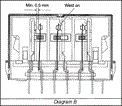
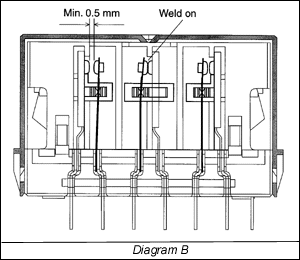
An internal force guided safety relay is used to achieve redundancy in the single fault protection safety circuit. These relays are designed to ensure that a 0.5mm gap between the open contacts is maintained should contact welding occur (Diagram B). Internal force guided relays comply with European Union's directive EN 954-1 defining single component failure control reliability, as well as with similar U.S. standards. ANSI B11.19-1990 – 5.5.1 states:
"Electromechanical systems that require redundancy and checking of relay contacts should use relays that are designed with mechanical linkages to provide a positive relation between normally open and normally closed contacts to check the contact operation. Solid-state devices do not have a mutually-exclusive normally-open, normally-closed contact arrangement. Other methods must be used to monitor the performance of these devices."
This completed machine safety guard door adequately conforms to European and U.S. directives. To review, the complete door incorporates (Diagram C):
- a solenoid interlock switch, which is used to detect barrier guard door position and to hold the door in a closed position when the machine is in cyclical operation;
- a general-purpose safety limit switch, which is used to detect guard door position and to provide input device redundancy;
- an internal force guided safety relay, which provides redundancy on the output and is used to implement internal circuit checking.

Implementing enhanced levels of safety helps to reduce the risk of employee injury and, as European class safety standards become more commonplace in
the U.S., employers must also create safer work environments to reduce liability against employee injury. OSHA's publication, Concepts and Techniques of Machine Safeguarding, spells out a basic safety principle that clearly places the responsibility for ensuring safety on the employer:
"A good rule to remember is: any machine part, function, or process which may cause injury must be safeguarded."
By incorporating such safety components as European standards-approved interlock switches and internal force guided safety relays into machine designs, employers in the U.S. can implement design standards that are sure to be landing on our shores in the not-so-distant future.
Resources Mentioned In This Article
U.S. Dept. of Labor
Occupational Safety & Health Administration (OSHA)
"Concepts and Techniques of Machine Safeguarding"
OSHA 3067
1992 (Revised)
http://www.osha.gov
American National Standards Institute (ANSI)
"Safeguarding When Referenced by Other Machine Tool Safety Standards—
Performance Criteria for the Design, Construction, Care, Operation."
ANSI B11.19-1990
http://www.ansi.org
National Electrical Manufacturers Association (NEMA)
Standard Publication No. ICS5-199x
http://www.nema.org
European Union
EN292-1, EN292-2 Safety Directives
EN1050 Risk Assessment
Reno Suffi is a proximity sensors and encoders product marketing specialist with Schaumburg, Ill.-based Omron Electronics Inc.