
Molex - Rugged Ethernet I/O Modules Integrate QuickConnect And Fast Start-Up Technology
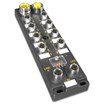
Latest from Molex is the new Brad HarshIO Ethernet I/O Module with QuickConnect and fast start-up technology to provide a reliable solution for connecting industrial controllers to I/O devices in harsh environments where liquids or vibrations may be present.
"As Ethernet flows from the office management level down to the factory floor, automation device manufacturers need to adapt their products to the constraints of industrial applications," said Eric Gory, global product manager, Molex. "When Ethernet is used to control the sensors / actuators on the robot tooling – such as on a welding robot – it is sometimes necessary to perform quick change of tools. In the automotive industry, for example, this tool change period is defined by manufacturers that the swapped Ethernet field devices must be able to start and operate in less than 500ms."
The modules bring high speed to the market and versatility to all industries using robots for repetitive tasks with precision. QC and FSU enable to start and operate the module in less than 500ms to meet the requirements for industrial applications in factory automation such as all type of body shop in automotive industry using robot tool changers. Delivering significant operational advantages over conventional I/O modules, the Brad HarshIO Ethernet I/O Modules have been successfully tested with Rockwell and Siemens-compatible PLCs (i.e. for EtherNet/IP the module is conforming to QuickConnect Class A device requirements to start and operate in less than 250ms).
Additionally the Brad HarshIO Ethernet I/O Modules support safety automation architectures using separate power supplies to power the inputs (sensors) and the outputs (actuators). The HarshIO Ethernet power connector includes separate grounding isolation between the input/logic ground and the output ground. This feature allows powering the module with 2 distinct power supplies that is commonly used in safety applications, says the company.
"Often, system designers are using safety relays that regularly perform pulse tests to be able to detect short-circuit, ground fault or an earth fault," explains Gory. "If an error is detected, the safety function is triggered and unwanted and dangerous plant conditions are therefore avoided. However, if the separate grounding for safety is not required by the system designer, the HarshIO modules can operate using a single power supply where the ground of both logic/input and output is identical."
SOURCE: Molex